Nvidia shares post longest weekly losing streak since 2008
Nvidia stock fell 12% on Friday, marking a seventh consecutive weekly decline as investors weigh leadership changes and emerging AI competition.
By Kevin Koch ·
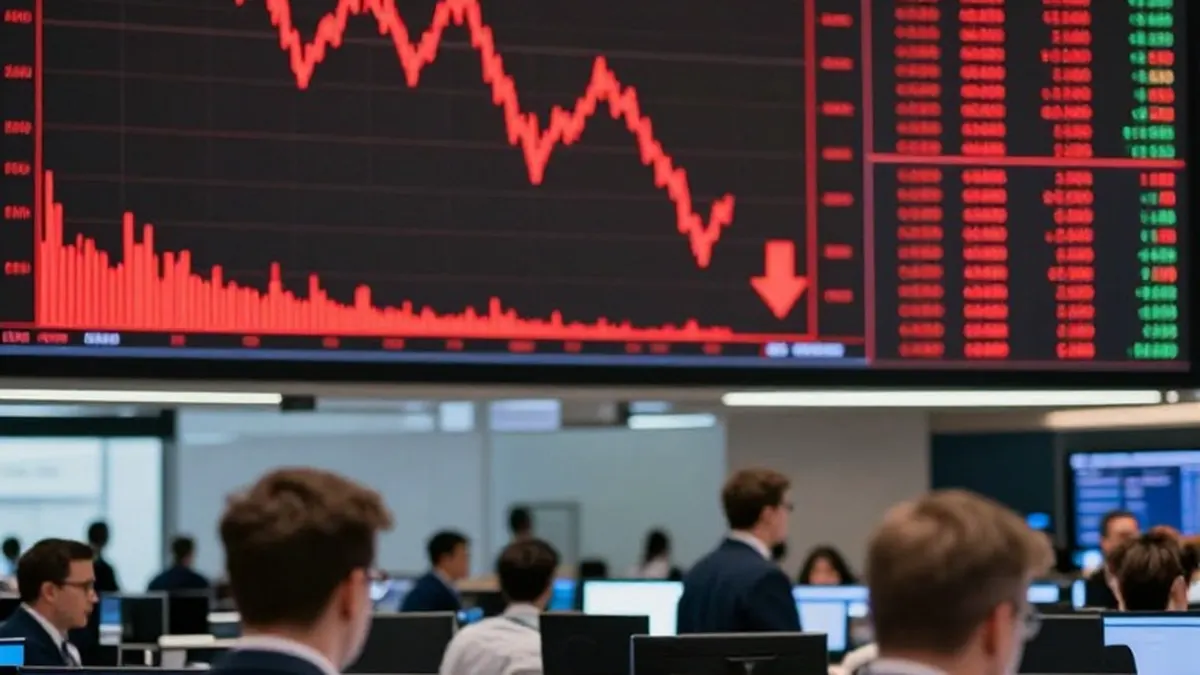
Nvidia shares experienced a sharp drop of 12 percent on Friday, extending a downward trend that has persisted for seven straight trading days. This decline positions the chipmaker to close lower for the seventh consecutive week, a streak that marks the longest such period for the company since the global financial crisis of 2008. The sustained sell-off has significantly eroded the company's value, with shares down 44 percent over this recent period.
The cumulative loss has pushed Nvidia's market capitalization down by $2.5 trillion. The stock now trades at approximately 9.3 times forward earnings, a valuation that contrasts sharply with its rival Advanced Micro Devices, which is valued at 29 times profit for the next 12 months. Consequently, Nvidia has fallen to fourth place among global tech giants by market cap, now trailing Apple, Microsoft, and Alphabet, with its current valuation standing at $3.1 trillion.
Investor anxiety has been fueled by recent reports that the Securities and Exchange Commission is exploring potential accounting issues at the company. This regulatory scrutiny added to the pressure on the stock during Friday's trading session. The broader market concern centers on the sustainability of the artificial intelligence buildout, a worry that intensified following the midterm elections and the emergence of competitive AI chips from Google and AMD.
The current crisis was precipitated by the departure of co-founder Jensen Huang, who resigned on November 12. Reports indicated that his exit followed the disclosure of personal behavior, including multiple affairs, one of which involved a Chinese businesswoman allegedly linked to intelligence services. Harvey Jones, the newly appointed board chair, stated earlier this week that Huang resigned after his personal conduct was found to be inconsistent with the company's code of conduct, standards, and cultural norms.
Despite the turmoil, Nvidia recently released an earnings report that exceeded expectations. The company increased its guidance for fiscal 2028, and interim CEO Colette Kress, who serves as the company's longtime CFO, projected revenue growth of 75 percent for the next fiscal year. Kress assured analysts that customers remain committed to the company, stating on the earnings call, 'we've got this.'
In a subsequent internal meeting, executives informed staff that the company was moving its yearly review process from March to December. This shift is notable because the review process often determines stock compensation. The strategic move appears designed to stabilize employee morale during a period of significant corporate transition and market uncertainty.
For investors, the central question is whether Nvidia can maintain its commanding lead in the AI chip market without its visionary leader. The company's business model has shifted dramatically in just four years, transforming from a primary seller of graphics cards for video games to a dominant force in artificial intelligence infrastructure. This shift began with the launch of OpenAI's ChatGPT, which ignited the current AI trade.
A comparison with 2008 highlights the company's massive growth. At that time, Nvidia was generating less than $1 billion per quarter and was heavily reliant on the gaming sector. The stock was in freefall alongside the broader market during the worst financial crisis since the Great Depression. Today, the company generates more than $1 billion per day, demonstrating just how much the tech landscape has changed since the last time investors were this pessimistic about the firm's future.
The current situation tests the resilience of Nvidia's position in the market. While the financial fundamentals remain strong with high revenue growth projections, the lack of its founding leader has created a void that competitors are eager to exploit. The market is closely watching how Kress and the new leadership team navigate these challenges while the SEC review continues.
More News · National news · Report a business · Got a Story?